A practical workflow for scoping, mapping, testing, validating, and reporting a web application pentest without losing the evidence behind each finding.
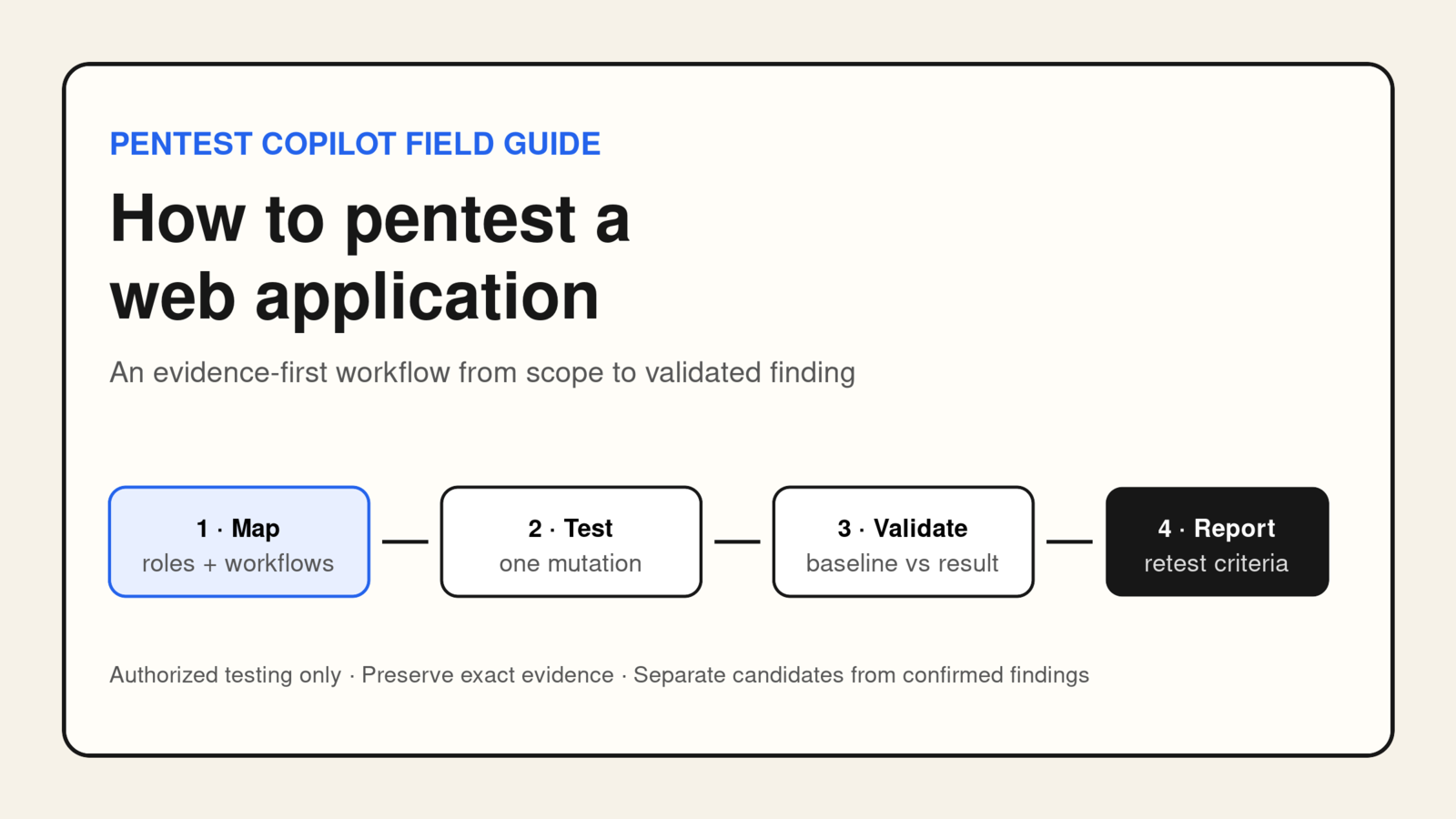
A customer signs in, adds an item to a cart, applies a discount, checks out, and downloads an invoice. A scanner sees five URLs. A penetration tester sees identities, state transitions, object ownership, trust boundaries, and several places where the server must reject a valid-looking request.
That difference is the center of web penetration testing. The job is not to send every payload to every parameter. It is to understand how the application is supposed to behave, change one security-relevant condition, and retain enough evidence to prove what actually happened.
The OWASP Web Security Testing Guide provides a broad map across information gathering, configuration, identity, authentication, authorization, session management, input validation, business logic, client-side behavior, and APIs. A useful engagement turns that map into an ordered workflow tied to the target.
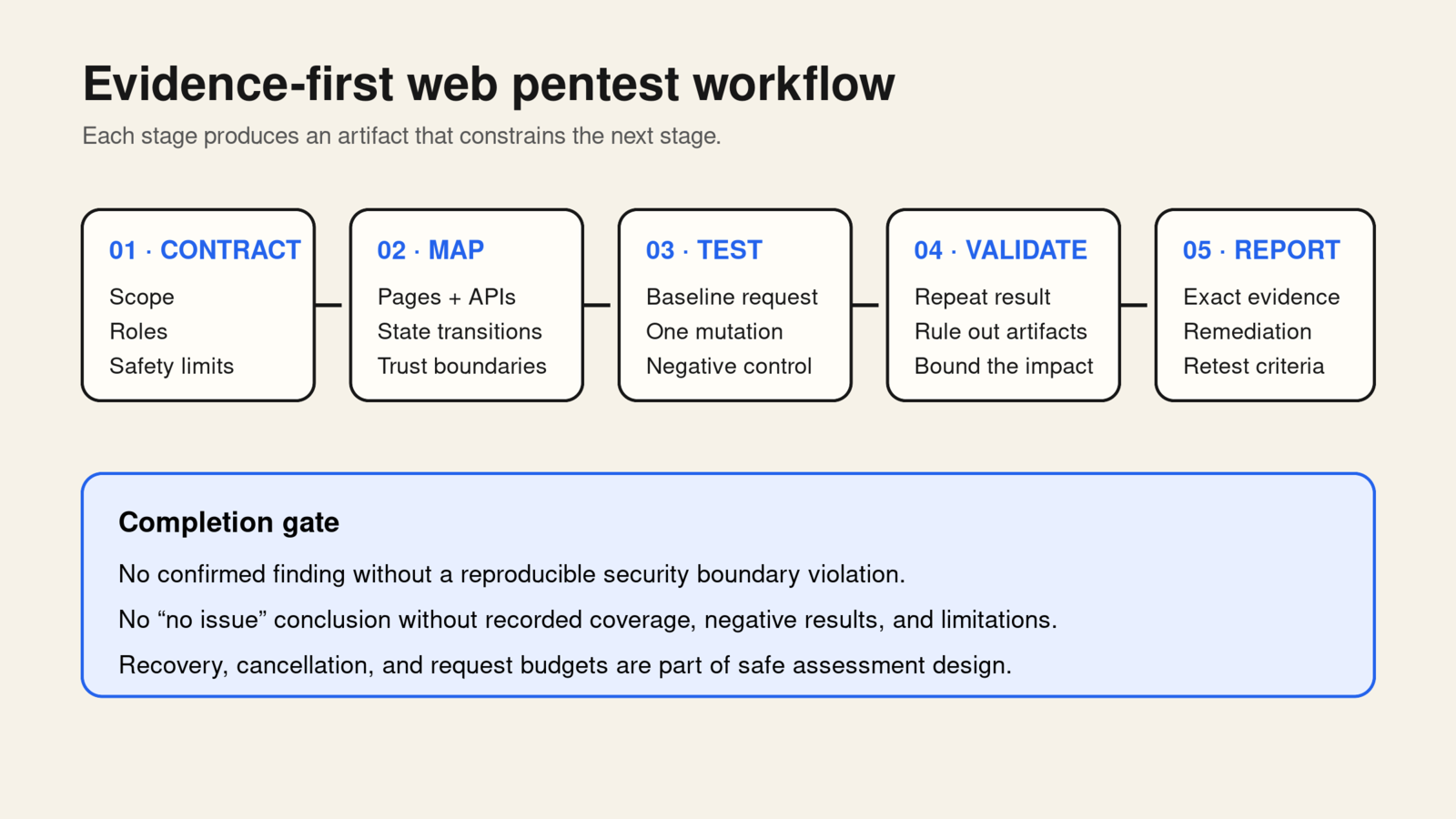
Before opening a browser, write down what grants authority to test.
At minimum, record:
This is not paperwork around the pentest. It is the first technical control. A redirect can leave an approved hostname. A file-upload flow can send content to a third-party storage service. A browser can load subresources from several origins. The runtime that sends a request needs a scope decision at the moment of execution, not only a sentence in the tester's notes.
The NIST Technical Guide to Information Security Testing and Assessment frames testing as a process that includes planning, execution, analysis, and mitigation. For application testing, the planning output should be concrete enough to answer: “May this exact action be sent to this exact destination now?”
An endpoint inventory is useful, but it is not an application model. The same endpoint can behave differently by role, account, object state, feature flag, or request sequence.
Build the map from real user journeys:
For the checkout example, the map might contain:
1sign in
2  -> create cart
3  -> add product
4  -> apply discount
5  -> create order
6  -> pay
7  -> download invoice
The important nodes are not necessarily the most complex requests. “Apply discount” may contain a business rule. “Download invoice” may contain an ownership check. “Pay” may depend on an earlier server-side state transition. A pentest should preserve those relationships instead of treating six requests as independent fuzzing targets.
Preserve captured application flows and authenticated browser state as assessment context. Later tests can then begin from an observed trajectory rather than reconstructing the application from isolated requests. The context is still only a map. It does not prove that a vulnerability exists.
Write each test as a falsifiable security statement.
Weak:
Test the invoice endpoint for IDOR.
Stronger:
A customer session must not retrieve an invoice owned by another customer when only the invoice identifier changes.
The stronger version identifies:
This format works beyond authorization:
Prioritize hypotheses by impact, reachability, and uncertainty. Start with the application's trust boundaries, not the payload list that happens to be easiest to automate.
Suppose the normal flow contains:
1POST /api/orders/ord_847/refund HTTP/1.1
2Host: shop.example
3Cookie: session=alice-session
4Content-Type: application/json
5
6{"reason":"duplicate","amount":4900}
Before testing, prove that the request is valid for Alice, the order belongs to Alice, the order is refundable, and the response creates the expected refund. That baseline answers whether a later failure came from the mutation or from a broken starting point.
Now create one test at a time:
ord_847 with a known Bob-owned order;Do not change the object, identity, amount, and state simultaneously. A surprising response is hard to explain when four variables moved.
Request-level execution is appropriate when the security decision is fully represented by HTTP. Browser execution is necessary when the test depends on DOM behavior, client-side storage, browser security policy, or a multi-step interaction that cannot be reproduced faithfully as one request.
The important boundary is the same in both cases: planning a test is separate from sending it.
In an evidence-first system, a structured test records:
Retain the transmitted request, the relevant browser state, and the resulting evidence with the assessment. Exploratory reasoning can suggest a payload, but it does not create a finding. The trusted result comes from the executed test.
Not every non-200 response is safe, and not every 200 response is vulnerable.
Consider the cross-customer invoice hypothesis:
| Result | What it means |
|---|---|
403 Forbidden with no data | Consistent with the invariant, assuming the request reached the intended check |
404 Not Found | May be a deliberate object-hiding response or a nonexistent fixture |
200 OK with Alice's own invoice | The server may have ignored the changed identifier |
200 OK with generic job metadata | Insufficient evidence of cross-customer access |
200 OK with Bob's invoice number and line items | Evidence that supports unauthorized object access |
| Timeout or connection error | An execution outcome, not proof of access |
The tester must connect the mutation to the security consequence. If the transmitted request did not differ from the baseline, the test did not test the hypothesis. If the response was never captured, the expected data cannot be claimed. If a timeout is itself the expected signal for a denial-of-service test, that expectation must be defined before execution and evaluated against the baseline.
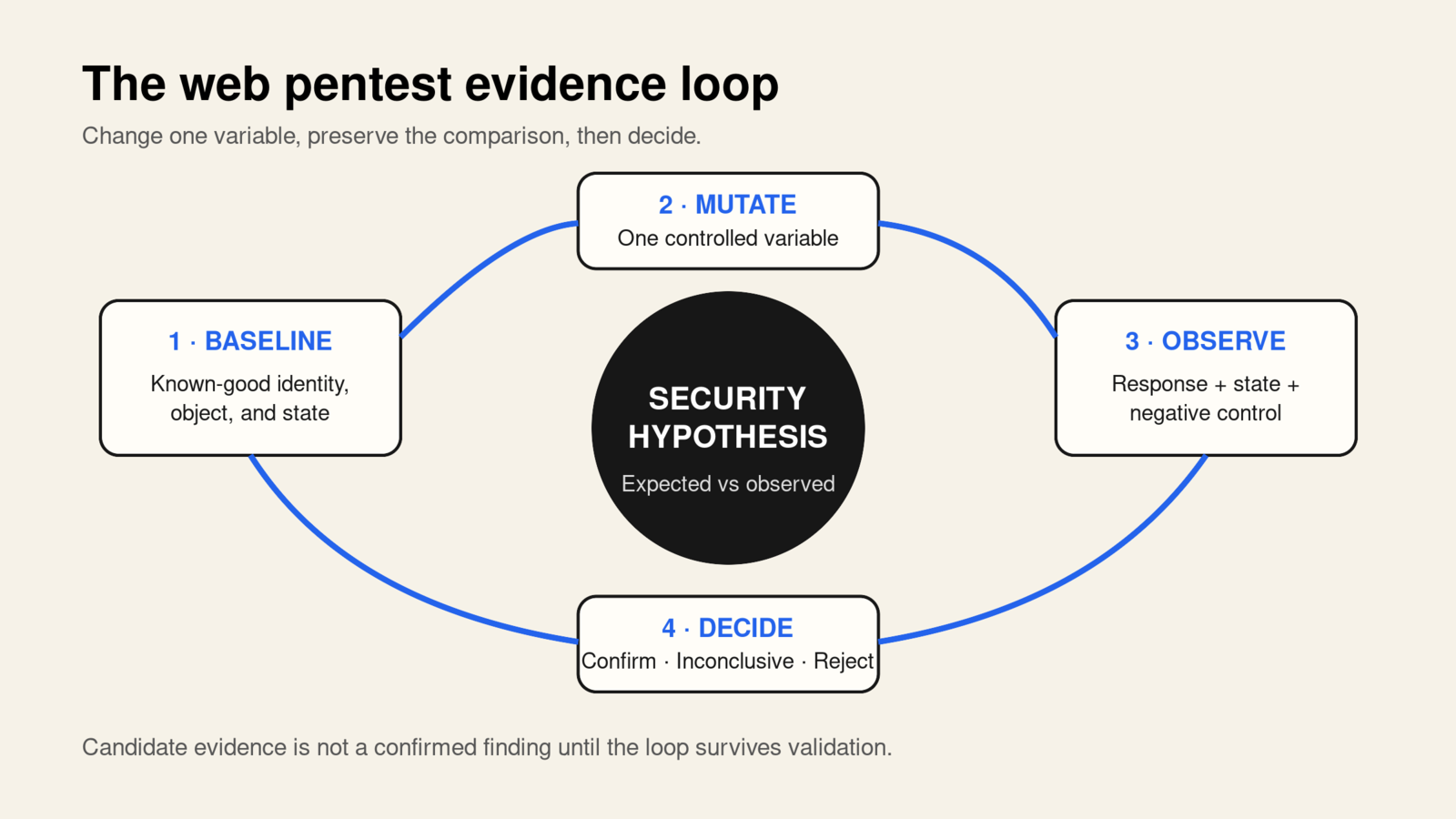
A useful test runner can determine that an indicator appears present. A defensible pentest still needs a separate question: does the recorded evidence prove the claimed vulnerability and impact?
Keep this separation in the workflow. An executed test may produce a vulnerability candidate. A validation stage should review the candidate against the request, response, relevant browser or out-of-band evidence, execution state, and the test's stated indicator. Evaluate each candidate on its own evidence.
This matters because plausible explanations are cheap. A response containing an email address may belong to the current user. A callback may have come from an approved public redirector rather than a private service. A timing difference may reflect normal variance. Validation cannot make automated testing infallible, but it prevents the reasoning loop from declaring its own hypothesis proven without another evidence gate.
Recovery should be informed by recorded state.
If a request returns no signal, inspect whether:
Then change one thing. Refresh the session, focus the flow, alter the execution mode, or refine the indicator. Do not repeat the same payload indefinitely.
Count entered executions against a defined testing budget, including errored attempts. A cancellation control should stop the loop and any follow-up work. Those controls make recovery observable and bounded.
“No more payloads” is not a completion condition.
Finish when:
The output should let another authorized engineer reproduce the issue without guessing which account, request, state, or response mattered.
For a practical application penetration testing engagement:
Measure a web application pentest by the security decisions it exercised and the evidence it retained, not by the number of requests it sent.
This article was reviewed on 2026-08-16 against the stable OWASP Web Security Testing Guide and NIST SP 800-115. The workflow was checked for practical coverage of mapping, controlled execution, evidence handling, validation, bounded recovery, and reporting.
The review focused on authorized external web application testing. It did not run a new production assessment or measure vulnerability yield.
The workflow is not an exhaustive test catalog. Mobile clients, thick clients, native protocols, source review, cloud configuration, and internal network testing require additional methods.
Application behavior and authorization remain deployment-specific. Automated mapping can miss hidden flows, validation can make an incorrect judgment, and safe execution depends on accurate scope, working test accounts, suitable fixtures, and available supporting services.