A technical comparison of coding-agent harnesses and autonomous pentesting systems, from tools and scope to evidence, validation, and cancellation.
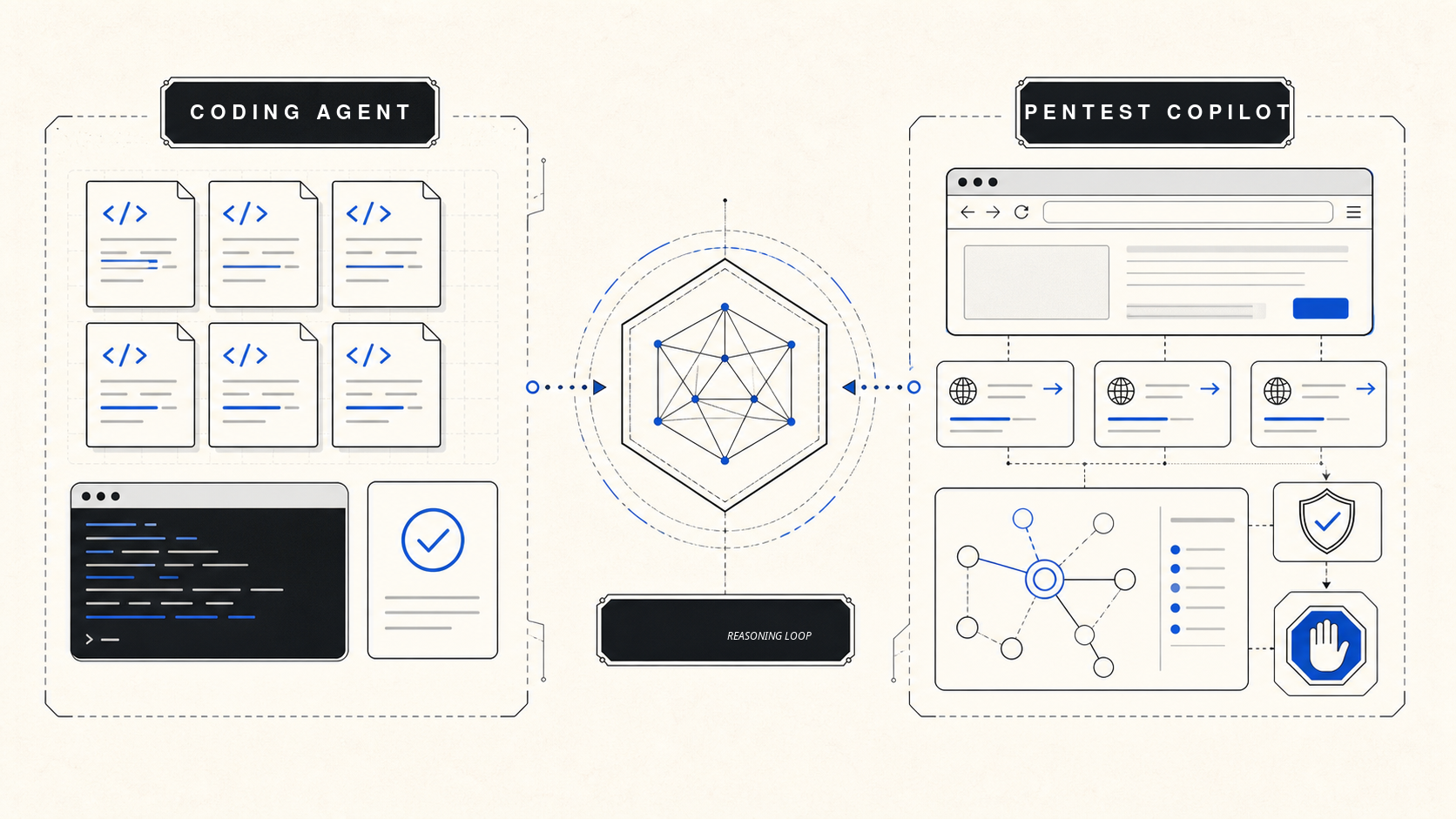
Open Z.ai's disclosure ledger and one column deserves a closer look: Harness. Public entries name environments such as Claude Code, Vulcanix, and VulnForge. That label is useful, but it is easy to read too much into it.
A harness is not the model, and it is not the vulnerability. It is the operating system around the reasoning loop: the context the model receives, the tools it can call, the state that survives between calls, the limits on execution, and the rule for deciding whether the work succeeded.
That distinction explains why a coding agent can discover a serious security bug and still be a different system from Pentest Copilot. The difference is not simply which model writes the next instruction. It is what the surrounding runtime treats as authority, action, evidence, and a final result.
These terms are often collapsed into "AI agent," even though they describe different responsibilities.
Anthropic describes Claude Code as an agentic coding tool that reads a codebase, edits files, runs commands, and integrates with development tools. Its permission rules can allow, ask about, or deny tool calls, and its Bash sandbox can enforce filesystem and network boundaries outside the model. Those are real runtime controls, not prompt suggestions.
The comparison with Pentest Copilot therefore is not "safe system versus unsafe shell." It is a comparison between different units of work. A coding-agent harness is organized around a repository task. An autonomous pentesting system is organized around an authorized target and an evidence-backed security assessment.
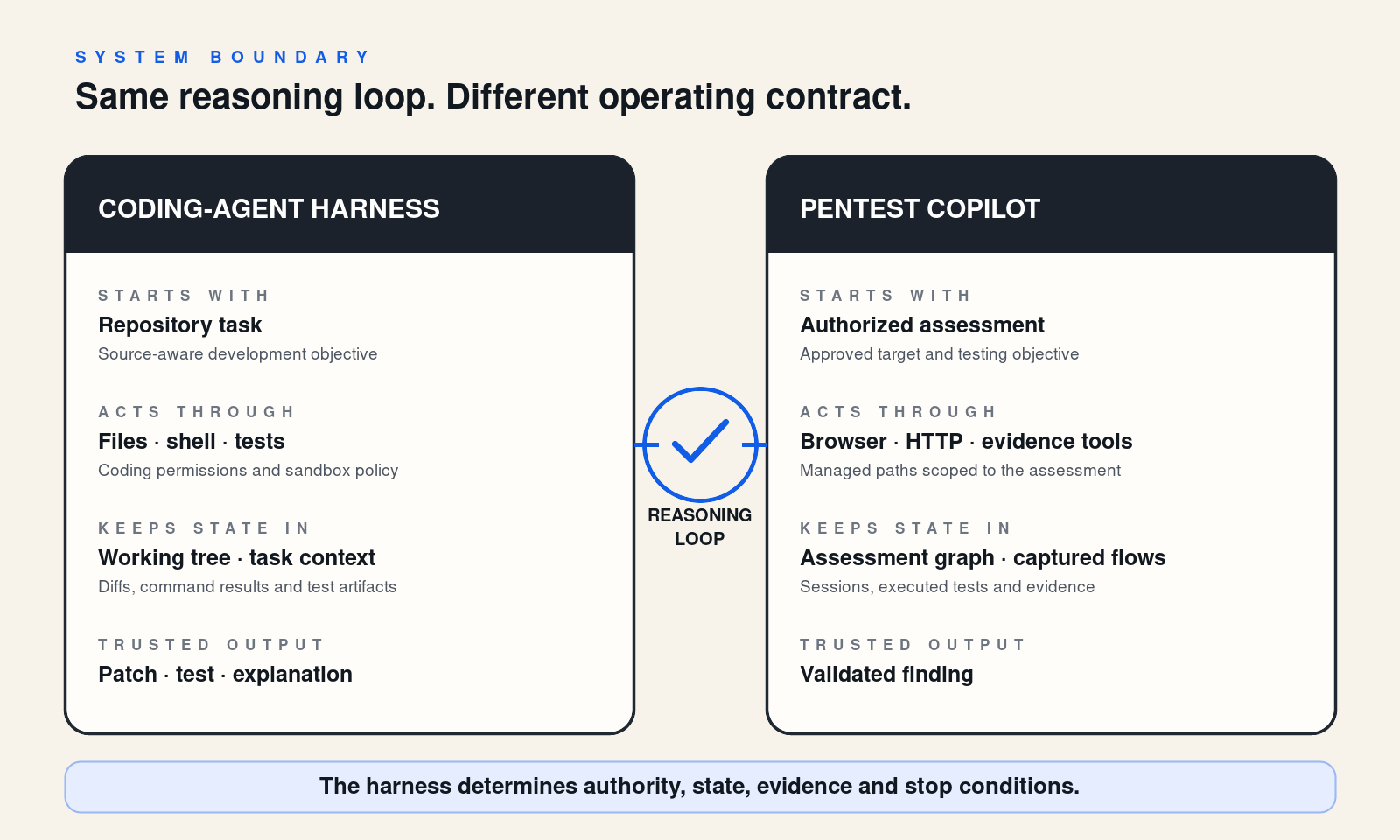
A coding agent starts with source-aware context. Its natural objects are files, symbols, dependency manifests, commands, diffs, and tests. Give it a request such as "find the missing authorization check in this handler," and it can trace call sites, inspect the data model, write a regression test, patch the code, and run the test suite.
That is powerful security work. The Z.ai ledger is useful evidence that general coding harnesses can participate in vulnerability discovery. Source access lets an agent follow data and control flow that a black-box tester cannot see. A repository also provides a concrete success artifact: a diff whose behavior can be checked by compilation, tests, static analysis, or review.
The default repository task does not, however, carry the full semantics of a penetration test. A shell command knows that it may contact a network domain if policy permits it. It does not inherently know that a particular customer authorized one hostname for one assessment, that a redirected private address is out of scope, or that a cancelled engagement must stop work already running near the target.
You can build those controls around a coding agent. Once you do, the added system becomes part of the harness. The important question is not whether the model could follow an instruction. It is which facts code outside the model will enforce.
Pentest Copilot changes the runtime contract around the reasoning loop. For an external application assessment, the system begins from observed application state and approved target scope. It gives the tester managed ways to inspect captured flows, read browser-session state, form a structured test, execute it through request or browser paths, and retrieve the resulting evidence.
The differences are concrete:
| Dimension | Coding-agent harness | Pentest Copilot external assessment |
|---|---|---|
| Unit of work | A repository task or development objective | An authorized target, assessment, and testing objective |
| Primary context | Files, symbols, commands, diffs, and tests | Observed pages, browser sessions, HTTP exchanges, application flows, and prior security state |
| Tool boundary | File and shell tools governed by coding permissions and sandbox policy | Managed browser, HTTP, graph, test-execution, and evidence tools scoped to the current assessment |
| Durable state | Working tree, conversation, and task artifacts | Assessment graph, captured trajectories, session state, executed tests, candidates, and findings |
| Success artifact | A patch, command result, test result, or explanation | Reproducible security evidence that survives a separate validation step |
| Failure behavior | Command or test failure returned to the agent | No signal, timeout, execution error, or inconclusive evidence recorded without fabricating a finding |
| Stop condition | Task completion, user interruption, or configured limits | Testing budget, exhaustion, confirmed candidate, external cancellation, and assessment lifecycle |
This outer state matters because web security testing is not one command. The same hypothesis may require an authenticated browser session, a captured multi-request flow, a modified request, an out-of-band callback, and a comparison between original and changed behavior. The evidence must remain connected to the target and the test that produced it.
The hard-boundaries design adds another constraint: the right to propose an action is separate from the authority to put that action on the wire. Destination policy, redirect checks, request budgets, and cancellation remain outside the model's reasoning.
The most useful way to understand the relationship is compositional. Pentest Copilot can use a coding-agent runtime as an inner orchestration loop. That loop contributes planning, tool selection, and recovery. The model behind it can also be changed without redefining the assessment data model.
The outer system supplies the security-specific contract.
Tools are bound to the current tester and its current assessment state. The model does not choose an arbitrary assessment identifier on every call. Graph reads expose only the captured application context that the worker is authorized to inspect. Live browser operations run against a provisioned session. Structured test execution is counted against a configured budget.
Raw network exploration also follows a managed path. HTTP command-line clients are not the source of truth for the tester. Requests flow through a request tool that can bound what enters model context while retaining the full response as an artifact. Shell probes may help form a hypothesis, but they do not create a finding. Only a structured test run can produce a vulnerability candidate for downstream validation.
This is why "which model found it?" is an incomplete engineering question. Models affect reasoning quality. Harnesses determine what the model can observe, what it can change, what is recorded, and which outcomes the rest of the platform will trust.
Consider an authenticated application flow:
1POST /api/exports HTTP/1.1
2Host: app.example.com
3Cookie: session=...
4Content-Type: application/json
5
6{"account_id":"acct_2048","format":"csv"}
The hypothesis is that changing account_id may return another tenant's export.
A coding agent with a browser or HTTP tool can make the change, inspect the response, and explain whether it appears vulnerable. That can be a valid manual research workflow. Its strength is flexibility. Its correctness depends on what state and evidence the surrounding task captures.
In Pentest Copilot, the hypothesis is attached to an observed application trajectory and the browser session that produced it. The tester structures the mutation, chooses a request or browser execution path, and runs the test. The result records which modification executed, the original and modified exchanges, relevant browser or out-of-band observations, and the indicator decision.
A 200 OK is not enough. The response might be the caller's own export, a generic queued-job object, or a cached page. The indicator must connect the changed identifier to unauthorized data or behavior. If the response times out, the request fails, or the expected evidence is absent, the result stays failed or inconclusive. The model does not get to turn an ambiguous response into a confirmed finding through persuasive prose.
When the execution produces a candidate, a separate validation stage evaluates it before it becomes a durable finding. That separation reduces a common agentic AI failure mode: treating a plausible explanation as proof.
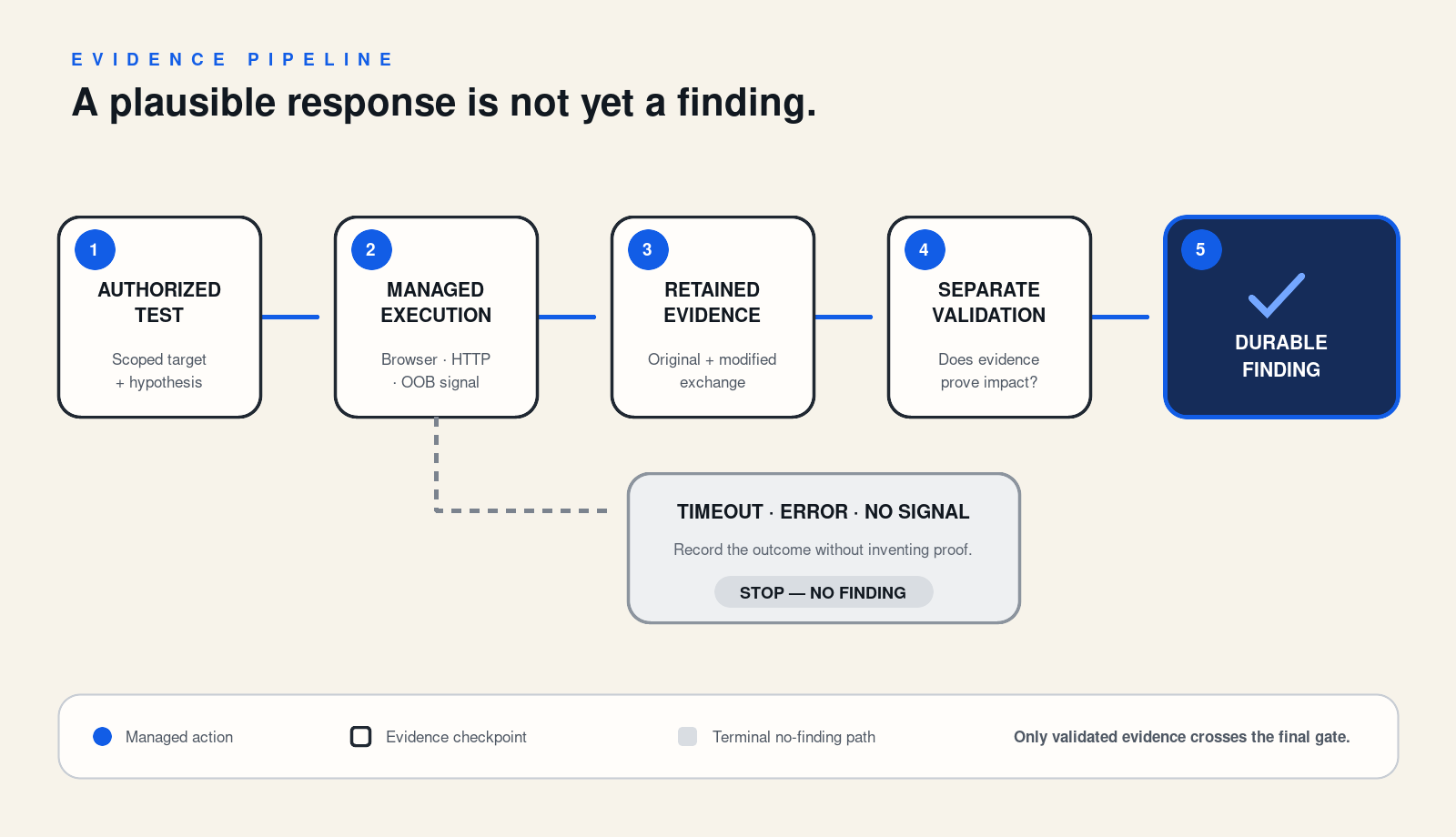
Security testing rarely succeeds on the first payload. A session expires. A browser action targets stale page state. A request is rate-limited. A response body is too large for useful reasoning context. The way the system represents these failures determines whether the next attempt is informed or merely repetitive.
Pentest Copilot returns a structured summary after an executed test. It distinguishes candidate-producing modifications, retryable outcomes, no-signal results, and errors. The tester can then inspect the retained evidence, adjust the trajectory or execution mode, and try a different hypothesis. Entered attempts consume the execution budget even when they error, which prevents failure from becoming a free infinite loop.
Cancellation follows the same principle. It is not a sentence added to the prompt. A stop signal changes runtime state and prevents the loop from continuing to execute tests. Queued and running work must converge on the cancelled assessment state.
These mechanics do not guarantee that every recovery decision is correct. They make the decision observable, bounded, and attached to the work that caused it.
Use a coding-agent harness when the job is repository-native: source review, taint tracing, patch development, test generation, dependency analysis, or reproducing a bug in a controlled checkout. Its access to code and development tools is the advantage.
Use a purpose-built autonomous pentesting system when the job is an ongoing external assessment: maintaining authenticated application state, coordinating HTTP and browser actions, enforcing target scope, retaining request-level evidence, separating candidates from validated findings, and stopping distributed work reliably.
The two approaches can be combined. A coding-agent runtime can supply the inner reasoning loop. Specialized security tools can supply the observations and actions. The outer assessment platform can own authorization, evidence, lifecycle, and reporting. That composition is more useful than treating product names as interchangeable agents on a leaderboard.
Evaluate an AI security system by the contract around the model: what is in scope, which tools can act, where state lives, what evidence survives, who validates the result, and how execution stops.
This article was reviewed on 2026-08-16 against the public Z.ai disclosure ledger, Anthropic's official Claude Code overview and permission documentation, the published Pentest Copilot network-boundary design, and the current Pentest Copilot implementation paths for agent tool scoping, captured application state, managed request and browser execution, test budgets, evidence retention, cancellation, and downstream validation.
The review focused on external application security testing. It did not reproduce a Z.ai disclosure, compare model benchmarks, or measure vulnerability yield.
"Coding-agent harness" covers many configurations. Claude Code supports fine-grained permissions and OS-enforced sandboxing, and organizations can add their own target controls and evidence systems. This article does not claim otherwise.
Pentest Copilot's guarantees also depend on deployment policy, configured budgets, target authorization, and the availability of its supporting services. Evidence validation reduces unsupported findings; it does not make automated security testing infallible.